" /> diacritic | art and culture: May 2006 Archives

« April 2006 | Main | June 2006 »

May 29, 2006

MAF06

maf06.gif

SECOND INSTALLMENT OF THE THAILAND NEW MEDIA ARTS FESTIVAL (MAF06)

APPLICATION 1 : “ONE:MANY” – EXHIBITIONS / WORKSHOPS / PERFORMANCES


EARLY CALL FOR SUBMISSIONS
DEADLINE: July 20 2006
THEME: ONE:MANY
DATES: 1-7 Nov 2006, Bangkok

The Thailand New Media Arts Festival (MAF) is holding its next event in November 2006 in Bangkok. The theme is ONE:MANY and will showcase video and film, outdoor projections, multi-user works and audio-visual performances. ONE:MANY aims to broaden and challenge 1:1 user interaction.

We welcome works by individual artists, collections from other festivals and proposals from artists who wish to act as co-curators.

APPLICATION 2 : “SPEED” – CITY-WIDE VIDEO SCREENING


EARLY CALL FOR SUBMISSIONS
DEADLINE: July 20 2006
THEME: SPEED
DATES: 1-12 Nov 2006, Bangkok

SPEED will include short video works of up to 3 minutes that feature expressive, elegant and rhythmic motion graphics and other types of dynamic and engaging moving images. This event is part of MAF06 November which will showcase works that impact on pedestrians and other passers-by. This extraordinary event will screen a selection of international video works everyday from sunset to sunrise: 8.00 PM to 3.00 AM. The venues are car-showrooms chosen to complement other indoor events MAF06 November are organizing. Selected works will be compiled as a sequence projected directly on to the front window of 20 selected car-showrooms across Bangkok.

How to submit works
Please convert your video work (up to 3 minutes) to MPG2 or VOB file format and write it on a DATA DVD or CDROM in full 25 fps PAL. Please do not send DVDs with menu etc., just the raw video file. The DVD should be submitted by snail-mail to this mailing address. Per-entry an online form should be filled AFTER the work has been posted by snail-mail.

More Information
MAF06. Submissions

Art Photography at Atelier Wonderful

flynam.JPG

The month of photography

A cycle of three photography exhibitions will take place at atelier wonderful from Saturday, May 20th to Wednesday, June 7th 2006. For the occasion, the atelier will be open on saturdays and sundays from 10am to 6pm and from monday to wednesday by appointment. Vietnamese photographer Bui The Trung Nam (Vietnam) will open the series on May 20th, followed by the work of Laure Bollinger (France) – from May 27th to 31st. Gulschan Göthel (Germany) will show her work from June 3rd to 7th. The series will end with a talk mediated by the three photographers about the practice of art photography.

laure fly.jpg

Created by Wonderful District, Atelier Wonderful is a place dedicated to contemporary creation in Ho Chi Minh City. It opens its doors every saturday for students, creators and art lovers who want to meet, share ideas and get information. Atelier Wonderful is neither a gallery nor an art center, it gathers different aspects in the compact space of a small artist studio:

-a small lounge, offering a display of documentation that can be consulted on place (art books, magazines, DVDs, digital data bank about artists),

-a workshop, which will accomodate regular presentation of artists' works or cultural actors' talks.

atelier wonderful
80 Nguyen Trai -1st floor
Ben Thanh Ward, District 1
Ho Chi Minh City, Vietnam
http://www.wonderfuldistrict.org

May 24, 2006

Roger Samuel Streitmatter

roger samuel streitmatter

Today, I received an email from my brother. The subject line read: Bad News. Living now for nearly three years outside of the US, if bad news arrives at all, it usually does by email. Several months ago, a close friend of the family emailed that my grandmother had passed, then a month later, my uncle. This morning, it was my father.

I hadn't seen my father in many years. To be precise, we met last in 1992 when I was still in the army, which makes it 14 years ago. In some ways, we were estranged. Male role models never played a formative part of my life (I've had three fathers: my birthfather, my adoptive father and my stepfather). In each case, they took a one-way ticket and left. My father, Roger, left when I was five and from that age until now I may have seen him maybe a handful times. That figures in around 5 times in 30 years.

I remember writing him letters on childrens stationary with stickers and crayons telling him how much I missed and loved him. I fantasized moving to Wyoming to be with him, working as a cowhand on some dusty ranch. Me, the 10 year old bronco swilling beer and branding cattle. Then I grew up a bit and slowly came to realize that there really may have been something wrong with my father.

My mother has always been forgiving towards my father. She recently once admitted that she always loved him. He was certifiably mentally ill, diagnosed with paranoia and schizophrenia. It sometimes became so bad that I would get letters in the mail from his alter ego, Rusty Stone. It sounds funny, but it's really the worst thing not to hear from your Dad in months or years and then a letter arrives and it's just not the same person. I eventually decided to not take it too hard and that's when I began ignoring him. Not with any malice, but because I was both busy and that it was just the simplest thing to do. That started when I was in high school and continued to this day. Now that he's gone, I have mixed feelings. I didn't mean to be the son that wouldn't speak to his father, as if it were some made-for-tv script. In fact I only found out he had cancer in the last couple of months. No one shares this news with us, so I guess it goes both ways. 

 I always felt concerned for my younger brother, who was in fact my Dad's natural born. I remember when Dad was around the house, but my brother was just a year old when he left. It seems that the male line of Streitmatter's have had a medical history of mental illness. But Joe turned out strong and he's a brother I'm extremely proud of.

A month ago, Mom forwarded me a letter from him. He indicated nothing was wrong with his health. He asked me to believe in Jesus, to keep my US citizenship. He wondered if we have ice cream or monkeys in Vietnam and if I'm ever going to write him. He said, now it's your turn to write. And the other half of the letter was from Rusty, who wrote me a poem. Rusty saw a Korean adoptee and that boy reminded him of me and he began to realize that he missed me. 

He wrote: "In my bible it says come unto me, you who are weary and heavy laden, and I will give you rest. I'm resting." 

 I imagined my father's death countless times. It was a good way to get out a cry, like a method actor. Where would I be? What would I feel. As with my grandmother, it was always clear: She loved me and knew I loved her. But with my father, its not as straight cut. Did I really love him or was I simply obligated to love him. Perhaps I sympathized for him as much as I loved him, and I certainly feel both today. So with that, I love you Dad. I hope you understand where I'm coming from.

I feel that I'm zoning out...

May 23, 2006

Biennalle Jakarta

jakartabienale.jpg

Our friend, Juliana Yasin, has been covering the Biennalle Jakarta. Please check out her coverage of the event and photoblog.

The opening of the Jakarta Biennale was held at Taman Ismail Marzuki [TIM] on 22nd of May 2006 by Mr. Sutiyoso; the governer of DKI Jakarta. The organisers, curators and participating artists of the biennale including invited guests were present at the opening. Program brochures and free copies of 'Canting' [fashion & beauty magazine] were handed out at the opening. There were speeches being delivered by Chandra Johan and the governor; Mr Sutiyoso, dance and music performances and a short video screening of history of the DKJ's [Dewan Kesenian Jakarta] biennale.

Information
Juliana Yasin. Jakarta Biennalle
Website. Biennalle Jakarta (Bahasa Indonesian)

May 19, 2006

4th Berlin Biennial for Contemporary Art

bb4.gif

The 4th berlin biennial for contemporary art, "Of Mice and Men," curated by Maurizio Cattelan, Massimiliano Gioni and Ali Subotnick, opened on March 25, 2006. The show includes works by more than 70 artists in twelve venues that dot the entire span along Auguststraße in Berlin-Mitte.

Information
4th Berlin Biennial for Contemporary Art 

DESIGNMAI 2006

designmai.gif

From May 18th to 21st, 2006, DESIGNMAI will be presenting more than 100 projects reflecting current design trends and acting as a meeting point for the international design scene in the city for the fourth time.

The close relationship between design and urbanity are to be at the center of this year’s DESIGNMAI: the central theme is DESIGNCITY. Design is seen as an increasingly important factor in the location and structure of our urban landscape. In Berlin these links are extremely clear, last but not least therefore in January 2006 Berlin was appointed as “City of Design” by the UNESCO.

DESIGNMAI 2006 is concentrated into four days and one central location: the DESIGNCITY in a former postal train station at Gleisdreieck. Here in hall A an exhibition emerges with contributions by over 60 designers, agencies and projects dealing with the theme City and Design, halls B and C assemble further exhibitions, presentations and the auditorium with lectures, debates and the symposium DESIGNCITY.

Information
Designmai 2006

May 18, 2006

Summer unrest for Summer Palace

summerpalaces.jpg

Summer Palace, nominated for the Golden Palm award at the Cannes Film Festival, the latest film by Chinese filmmaker Lou Ye, has been censored in Beijing, apparently for "aesthetic reasons". The censors contend that the deliberate use of blurred images and other cinematic effects have rendered the film unworthy to show at Cannes. To to be up front, I've yet to see this film, though his earlier two films, Purple Butterfly [2003] and Suzhou River [2000] remain top on my list rivaling the best of his contemporaries, Wang Xiaoshuang and Jia Zhang-Ke) and also make extensive use of handheld camera shots and blur. One begins to question the aesthetics given the story being told, who the Guardian Unlimited summarizes as "A young woman leaves her village to study in Beijing, soon beginning an intense affair before being separated during the Tiananmen protests" or more fully by the IMDB:

Country girl Yu Hong leaves her village, her family and her lover to study in Beijing. At university, she discovers an intense world of sexual freedom and forbidden pleasure. Enraptured, compulsive, she falls madly in love with fellow student Zhou Wei. Driven by obsessive passions they can neither understand nor control, their relationship becomes one of dangerous games - betrayals, recriminations, provocations - as all around them, their fellow students begin to demonstrate, demanding democracy and freedom. Protests collapse, and Yu and Zhou lose each other amidst the social chaos and panicked crowds. Zhou Wei is sent to a summer military camp, and on his release moves to Berlin, fleeing both his country and memories of Yu. She finds a job, a lover, but can not forget Zhou. In Germany, social unrest is mounting: calls for freedom, demonstrations for democracy. A familiar story for Zhou. Weary, still haunted by Yu, he returns to China as the Berlin Wall crashes down. He finds her at last, in a small town. From evening to dawn, their future stretches before them, two changed souls in a changed world. 

According to a post on Danwei:

Earlier rumors said that the censors requested changes because of "sensitive subject matter" related to some of the historical changes of the 1980s (read: Tiananmen and the collape of communist East Germany), and Lou Ye was said to have refused to alter his movie. Other rumors said that the movie was being held up because it had received international financing. 

But this latest rejection comes for technical reasons, say the producers - "the picture was too fuzzy, and the sound was too low." According to TBN:  "Lou Ye tried out some new artistic methods in this film, but the censor committee judged it as not being up to technical standards. This struck a blow to the director, and he cannot accept this result at present." According to Ms. Nai'an, she believes that Lou Ye was perhaps pursuing a few visual effects and used fuzzy lenses, but the censors were unable to accept this kind of artistic experimentation. "

summerpalace2_web.jpg

 The linking of the events of 1989 to the idea (and title of the film) of the summer palace is brilliant and demonstrates the creativity and the art of this important, though relatively unknown, filmmaker. Sanssouci, the former summer palace of Frederick the Great, King of Prussia at Potsdam just outside Berlin in Germany, is often counted among the German rivals of Versailles (source: Wikipedia) and Yiheyuan Summer Palace, situated 15 kilometers from central Beijing designated, in 1960 by the State Council, as a Key Cultural Relics Protection Site of China. Both architectures represent the power and perceived grandeur of the state and are located in close proximity to the cities that in 1989 saw a peoples resistance against the ruling communist state that culminated in the demise of one and the consolidation of the other.

Written by Lou and his wife Yin Li with Mei Feng, "Summer Palace" touches on pivotal historical events that might normally raise a communist censor's eyebrows, with one key exception. The film deals with the collapse of the Berlin Wall, the disintegration of the Soviet Union, former Chinese leader Deng Xiaoping's historic tour of south China in 1992 -- which launched the reforms now driving the capitalist boom -- and Hong Kong's return to China from Britain in 1997. "Summer Palace does not include reference to Tiananmen," Fang (Producer) said, referring to the death of student democracy activists in Beijing's main square in 1989 at the hands of the Chinese army. "The film's themes are noncontroversial, so there should be no problem for passing the Film Bureau's examination," Fang said. (Source: Hollywood Reporter)

Very well put. Perhaps there isn't any direct reference to the "June 4th Incident", which for me makes the film ever more intriguing. Lou Ye, a filmmaker that I've been raving about for years... go and see this film. If anybody has access to it, please drop me a line.

Sources
Danwei. Summer Palace rejected over aesthetic differences
IMDB. Summer Palace Summary
Hollywood Reporter. 'Palace' producers challenge Beijing censors
Kaiju Shakedown. Cannes gets Lou Ye in Hot Water

May 16, 2006

Ou Ning interviews curator Hou Hanrou

A very interesting dialogue between Ou Ning (of the Alternative Archive in China) and international curator Hou Hanrou, who made a short visit to Saigon in 2004. On exhibitions, Hou Hanrou says:

Exhibitions first and foremost have to be experimental, and should do their utmost not to repeat things that people have seen before - they should give people a new visual experience. That said, a purely visual experience is not enough, there should be new experiences for the mind and body as a whole. Perhaps the most important element in any successful exhibition is its orientation to a certain time and place, its cultural backdrop, its significance within its locale. For me, an exhibition is a special activity, a special event. It is not simply a matter of taking existing works and hanging or installing them. From the choice of theme, artists, and artworks to the actual realisation of the exhibition itself, all of these things represent a living and breathing process. Contemporary art is not just purely about making works of art. On top of this it also has the possibility of constant continuation, it is a creative process that is always deepening. An exhibition is the equivalent of amplifying or emphasising the development process of a group of artists or a cultural issue, or like showing people a particular moment in time enlarged. At the same time, an exhibition can give artists the opportunity to undertake more experimental work, an opportunity that might not otherwise arise. When I undertake an exhibition, if at all possible I invite many artists to make their works on site. Very seldom do I use their existing works, and on the occasions when I do, I integrate them with the specific locale of the exhibition, re-examining the relationship of the work and the exhibition space, not to mention the relationship of that work to other works and to the local audience. 

For the full interview in English please visit:
Ou Ning. Talk Goes on... Interview with Hou Hanru

May 15, 2006

Telekolectif - Performativity

telekolectif.gif

PERFORMATIVITY: Call For Submission

Telekolectif invites artists who are permanent residents or citizens of Southeast Asia to submit performance artworks made for video for selection in Performativity. Selected works will be considered for showcase in and outside of Thailand. Stipulated are the requirements:

Project Name: Performativity
Eligible Artists: Citizens / PR of Southeast Asian countries
Content: Performance artworks made for video, made in 2006
(Not documentation of performances or video pieces meant to be treated as short film pieces)

Work Format: VHS (PAL) / DVD / VCD / Mini DV
Running Time: < 10 Minutes
Written Synopsis: < 300 words (In .doc or PDF format)
Artists’ CV: In .doc or PDF format

Submission: To be received in Bangkok by 31 July 2006

Address: Telekolectif, 128 / 94 Soi Term Boon Bangkhunnon Rd.
Bangkoknoi Bangkok 10700, Thailand
Email: telekolectif@yahoo.com

Main Exhibition space:
Photography Bar, Bangkok
Fringe Events: Exhibition in public spaces (Mobile Exhibition) in Thailand.

Current Screening Partners:
Chulalongkorn University (Bangkok, Thailand), Assumption University (Bangkok, Thailand), Gallery Ver (Bangkok, Thailand), Bed Supper Club (Bangkok, Thailand), Media Art & Design, Chiang Mai University (Chiang Mai, Thailand), Wunderspaze (Singapore), 6th Asian Film Symposium, The Substation (Singapore), Round Eye Glass Café (Manila, The Philippines), A Little Blah Blah (Ho Chi Minh City, Vietnam), 18th Street Gallery, Santa Monica, California (USA)

Telekolectif: Khairuddin Hori (Singapore), Thanavi Chotpradit (Thailand), Manuporn Leungaram (Thailand), Theerada Suphaphong (Thailand), Reungsak Anuwatrawimon (Thailand), Patricka Chulamokha (Thailand)

More information
Telekolectif. Southeast Asian Young Curators Network
 

May 11, 2006

The Hunger Artist

cambodia-coconuts.jpg

Hopefully my recent article for the London-based art magazine, Contemporary, will give me some spending cash.


May 10, 2006

EasyRiders Phnom Penh

easyriders.jpg

Photography by Isabelle Lesser
at Java Cafe & Gallery
56 E1 Sihanouk Boulevard
Phnom Penh

May 11 - June 18, 2006
Slideshow and exhibition opening
Thursday, May 11, 6-9 pm
www.javaarts.org 

May 9, 2006

What's In a Name, Part 2

Danwei posts an interesting article on magazine publishing in China. One option is to publish a popular culture magazine under the license of Gansu Geology Review.

Danwei. Wait, what's the name of this magazine again?
Diacritic. What's in a Name (Part 1) 

May 6, 2006

Poverty of Saigon Student Life

saigonstudents1.jpg

This Saturday, exhibitions in two venues, Atelier Wonderful and Saigon Open City, featured new works by students - many currently studying at the Ho Chi Minh City Fine Art University. It was refreshing, not so much in that the work was particularly strong or new, but for the young energy and ambition that pervaded gatherings. There was a solid sense of pride among the young. And if you live in Vietnam, you know that students are rarely this bold. They are not accustomed to being given the freedom to express their opinion.

Thao, a first-year student at the university shared her recent video work. It's interesting that she took one idea, that is using her hands to communicate stories, and recycled this device through three videos. The videos were screened on monitors and projected onto the floor of Atelier Wonderful and then followed by an artists presentation where she and friends facilitated an very honest and open dialogue. The work, technically, had many problems. Many agreed that the coupling of pop music to the work was problematic. Thao, herself, acknowledged that she ultimately was not satisfied with the work but would work to improve the concept and execution of future work.

saigonstudents2.jpg

Later that evening, several other university students presented installation based work in the studio spaces at Saigon Open City. There wasn't a lot of innovation in the installations were certainly far from being site specific - the work could have been installed anywhere without a significant change in meaning. But many were labor intensive and heart felt. Others activited their installations through performances and audience participation. Other installations used prerecorded sound and lighting effects.

The kicker is that the Ho Chi Minh Fine Art University to this day refuses to incorporate installation, performance and video into their curricula despite the wide student interest in these forms. The reluctance and indeed opposition to contemporary art practices reveals the core of the problem facing art education in Vietnam - that is that the instructors are not accountable to the students. They needn't education themselves, nor is their interpretion of "what is art" open for debate. Also, the education system is unwilling to invest in new teachers or retrain their existing faculty.

For example, Thao used her own camera to make her video work and the Atelier Wonderful to make final edits.  In fact the Ho Chi Minh City Fine Art University has several workstations, a 3ccd PAL video camera, a video monitor and tape deck - all of which are locked up onlyto be used for recording university ceremonies and official events. Students do not have access to the equipment nor are there teachers at the school that can teach courses in video art. I taught a contemporary video art course at the university in 2003 and midway through the 2nd semester, my course was put on indefinite review (meaning I was fired without actually saying so). There has not been a contemporary art course at the university since.

The students are eager to learn. They are seeing international work and are filled with questions and need critical feedback. Until the university can reform, they will be getting a large part of their education at spaces outside of the university. Precisely because these spaces are the only ones that will allow to freely experiment.

Guy Debord, artist and leading figure of the Situationist art movement, one lamented in an essay about the poverty of student life. This preceded the 1968 student riots in Paris. Burn baby burn. 

May 3, 2006

Comfortably Lost

Last night I participated in a conceptual art work by Sue Hadju which had me sleeping in a street level window installation for 9 hours aided by two doses of Ambien (coincidently, the word can be phoenetically understood in Vietnamese as "warm beach", ấm biển). This morning I thought of the Pink Floyd song, "Comfortably Numb". As I now approach teaching again this late June at RMIT, I am reminded of the teaching style of some of my best teachers:

It's definitely a process of give and take for both sides. So whenever in doubt, I err on the side of keeping my mouth shut. As a result, I figure that my students spend most of their time in a state of being lost -- but ideally "comfortably lost." 

Source
Maeda's Simplicity. Comfortably Lost 

May 1, 2006

Back in the window

cc-1.jpg

This Tuesday evening, I will return to the window as a participant in Sue Hadju's Magma: We're Not Counting Sheep installation at Galerie Quynh in Saigon. You can see it live from the street from 9 PM - 6AM as well as viewed online during the same hours from the gallery website.

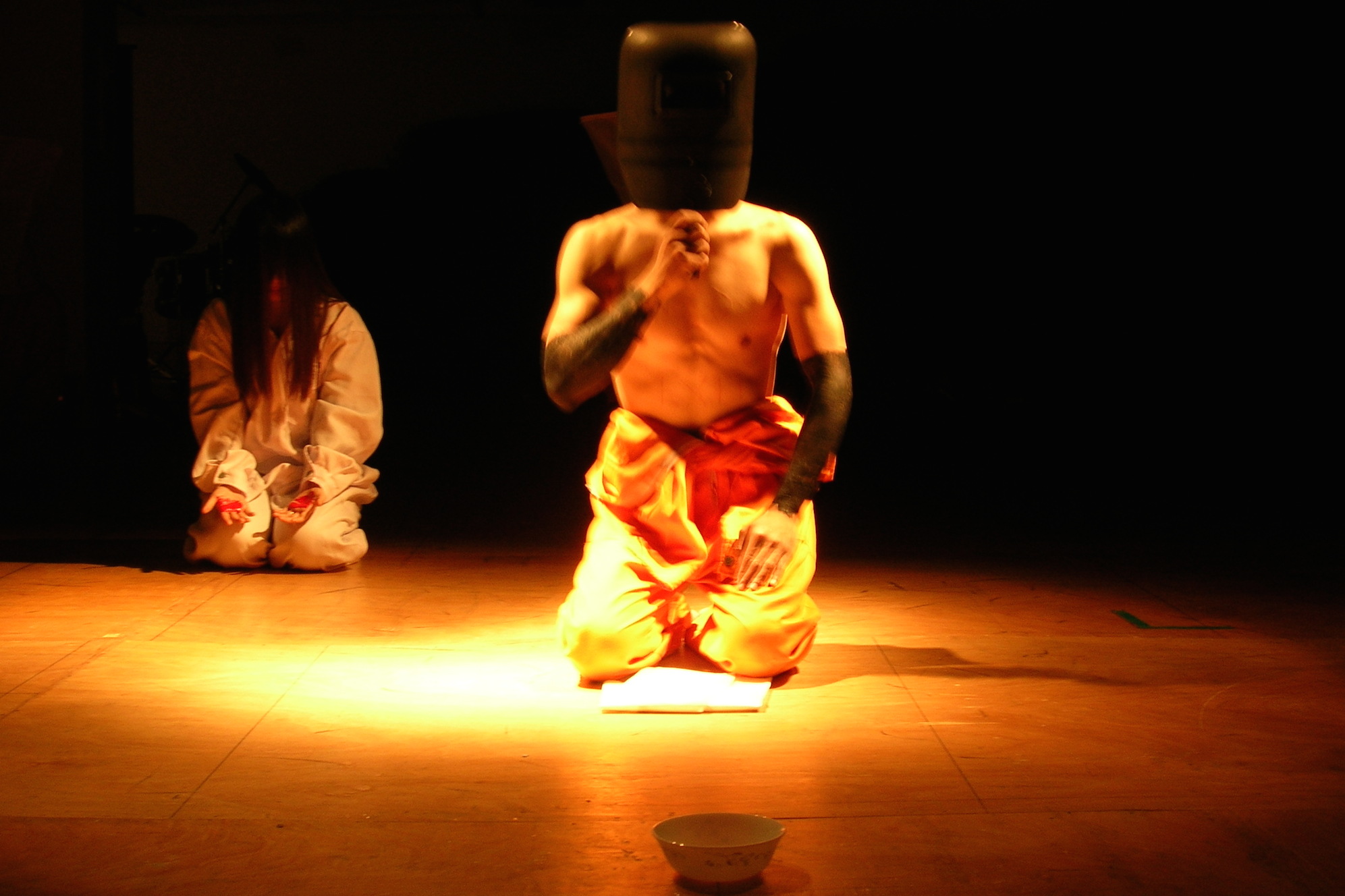
The last time I did a performance using street level windows spaces was in Boston at the Tremont Gallery, curated by Hiroko Kikuchi. Six concurrent performances in six windows. Four hours.

cc-2.jpg

For information on how to view Magma: We're Not Counting Sheep either live or online, please visit the gallery website.

Information
Website. Galerie Quynh
Performance. Culture Clubbing