" /> diacritic | art and culture: April 2006 Archives

« March 2006 | Main | May 2006 »

April 28, 2006

Sovanna Phum in Danger

sovanna_phum_fundraiser.jpg

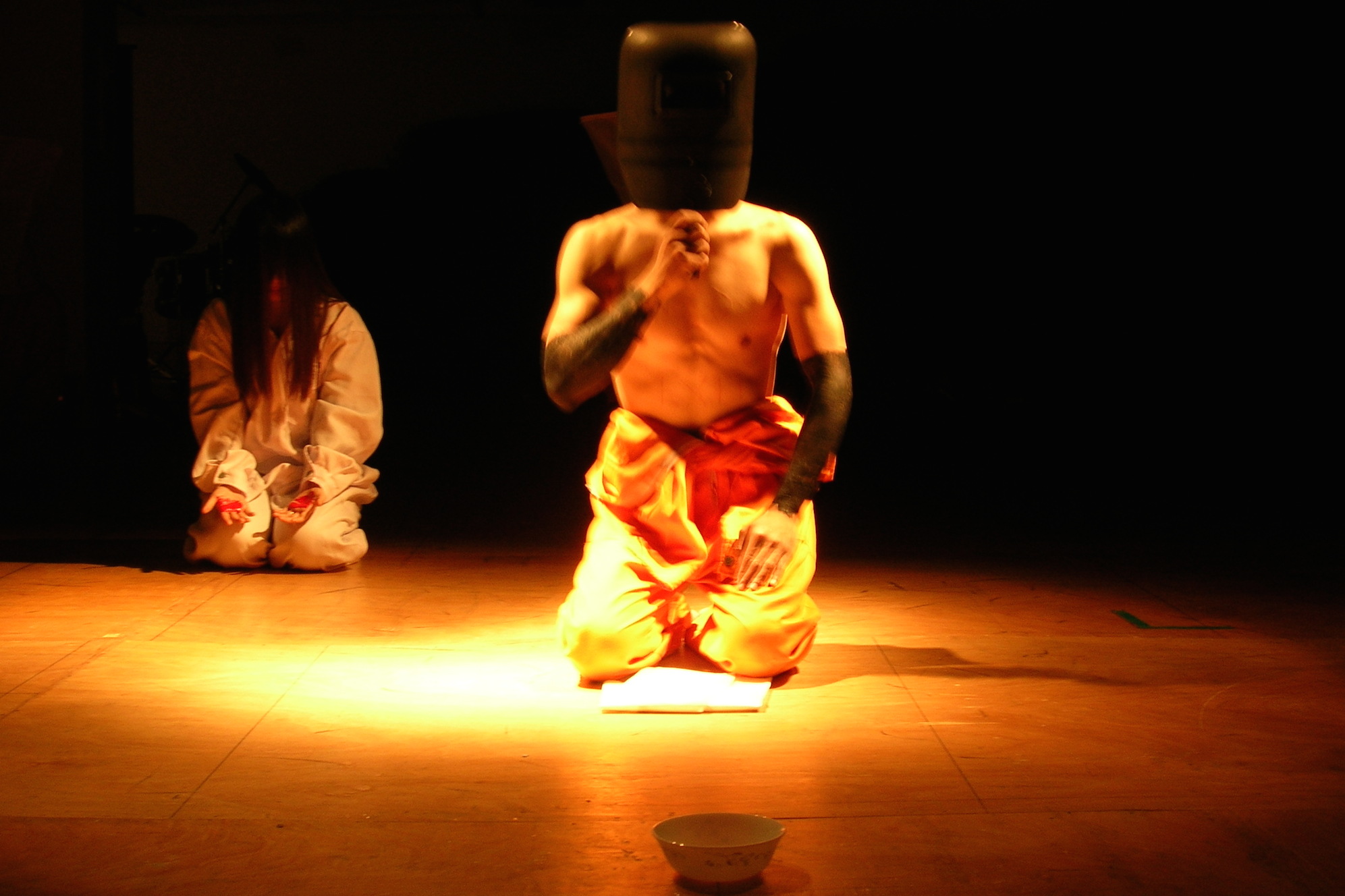
I saw a performance by the Sovanna Phum troupe over a year ago. The sounds and images still linger. Regretably I was not able to visit during my recent exhibition in Phnom Penh in early February. I fear that I may not see them again. If you are in Phnom Penh this early May, I strongly recommend that you see this production. The experience will be burned in your mind for a lifetime. You will not remember Phnom Penh without remembering this troupe. It's a shame to see the millions of dollars being spent on the construction of the new United States fortress embassy in Phnom Penh when talent like this is left for waste. Particularly in light of Cambodia's recent tragic history that saw the decimation of artists by genocide. It's not a far stretch to see that the destruction of the arts continues through an economic rather than a military machine. Please visit Sovanna Phum. -RST

--- 

Sovanna Phum, the only organization presenting professional performances every week is facing a grave funding crisis.

An exceptional 3-day fundraiser (May 4th, 5th and 6th 2006) will happen at 7:30pm in the Sovanna Phum theatre comprising the première of "Sokacha", a new mixed media adaptation of an extract from the Reamker and a sale of shadow puppets at 5% discount. Admission will be by donations of $5 or more.

It is also possible to support Sovanna Phum visiting our Gallery to buy shadow puppets, masks, music instruments made by our artists.

Sovanna Phum hopes to raise $12,450 from this fundraiser, which will cover costs for the next three months while we seek for long-term funding.

To raise funds to cover this short term crisis Sovanna Phum is calling for support from Embassies, local and international Organizations, private sector and everyone who like and believe in Khmer culture, helping the Association to pursue its activities.

What is your donation for?

*    $700 pay Sovanna Phum rent for a month
*    $400 pay Sovanna Phum roof replacement
*    $200 pay Sovanna Phum electricity for one month
*    $100 pay colored Sovanna Phum posters for 1 month
*    $70 pay Sovanna Phum telephone for one month
*    $40 pay one Sovanna Phum artist fees for 4 performances
*    $25 contribute to Sovanna Phum artists for volunteer rehearsals for new performances
*    $10 participate in Sovanna Phum costume making

For more than 10 years, passion and enthusiasm from both the staff and the artists of Sovanna Phum (120 professional artists, mainly graduates from the Royal University of Fine Arts)  has led to Sovanna Phum being an internationally known centre for the performing arts and a centre for creation and presentation in Cambodia. Sovanna Phum is also well known to lead some awareness campaigns within development projects.

However, Sovanna Phum depends on funding for individual projects and has no core funding to support the venue.

Sovanna Phum’s aims are to enable professional Cambodian artists to make a living from their art, through regular performances; to nurture, preserve and promote the treasures of Khmer culture to local and international audiences; and to organize awareness and prevention campaigns linked to the development of Cambodia (health, education, environment, human rights and democracy) through mobile traditional performances spreading educational messages.

For any further information, to make reservation or to provide us with any other kind of support, please contact:

Segolen Guillaumat
Tel: 023 987 564
email: sp.project@online.com.kh

Destined to Meet

destined-to-meet.jpg

On occasion I'll be posting photographs I've taken over the years. The image above "Destined to Meet" was taken in 2004. If there's any word that I can't stand, it's destiny. I rather like to think of this image as the visual to Haruki Murakami's short story, "On Seeing the 100% Most Perfect Girl" except this is Manhattan and not Harajuku:

One beautiful April morning, on a narrow side street in Tokyo's fashionable Harujuku neighborhood, I walked past the 100% perfect girl.

Tell you the truth, she's not that good-looking. She doesn't stand out in any way. Her clothes are nothing special. The back of her hair is still bent out of shape from sleep. She isn't young, either - must be near thirty, not even close to a "girl," properly speaking. But still, I know from fifty yards away: She's the 100% perfect girl for me. The moment I see her, there's a rumbling in my chest, and my mouth is as dry as a desert.

Maybe you have your own particular favorite type of girl - one with slim ankles, say, or big eyes, or graceful fingers, or you're drawn for no good reason to girls who take their time with every meal. I have my own preferences, of course. Sometimes in a restaurant I'll catch myself staring at the girl at the next table to mine because I like the shape of her nose.

But no one can insist that his 100% perfect girl correspond to some preconceived type. Much as I like noses, I can't recall the shape of hers - or even if she had one. All I can remember for sure is that she was no great beauty. It's weird...

Magazine Project

nadiff-1.jpg

Yesterday, we had a great meeting at the atelier and made some breakthroughs concerning the conceptualization of our magazine project. We have some new energy. Some of the recent submissions from abroad are absolutely moving!

April 26, 2006

Seiji Shimoda of NIPAF in Saigon

shimoda1.jpg

Seiji Shimoda, director of the Nippon International Performance Art Festival (NIPAF) spoke yesterday evening with guests at Atelier Wonderful about the festival in Japan, the challenges of performance art in Asia and his own experience with the avant-garde movements in Japan in the sixties and seventies from which NIPAF emerged.

I was interested when Seiji said few critics can speak about contemporary performance art in Japan, despite Japan having an established and well-documented avant-garde art history dating back to the Gutai movement in the 1950's. He claimed this history is precisely what prevents many critics from engaging with the contemporary art performance practice. Critics have tended to specialize in these established historical movements or forms. Several of the directors of such large international art events as the Fukuoka and Yokohama triennials were colleagues of Seiji many years before and they remain close. Yet performance has still to be fully integrated into these venues.

It was also refreshing to hear Seiji's own perspective on NIPAF and his reply to critics of various performance art festivals in Asia. NIPAF was founded and continues to be a venue for emerging artists, including currently enrolled university students. As such it is less interested in highlighting large performance works or established big names. In fact, NIPAf has been an enabler for such well-known artists as Ma Liuming (China) where it worked to provide him his first entry to perform outside of China. Many of the organizers of other peformance art festivals in Asia such as PIPAF and Asiatopia were first participants in NIPAF years ago. Ly Hoang Ly, Ngo Thai Uyen and Bui Cong Khanh - three of the five members of ProjectOne, have performed in Japan with NIPAF in different festivals.

NIPAF, founded in 1993, now moves to its seventh festival this June. Rather than perform at the next festival I've instead opted to assist Seiji in organizing a future event in Southeast Asia. I hope to be able to recommend a young artist or student that has yet to interact outside of Vietnam in my place.

shimoda2.jpg

I would also like to thank artist Sandrine Llouquet (above in pink, with artist Ly Hoang Ly), Co-director of Atelier Wonderful, for providing a forum for Seiji. 

REMINDER
Sue Hadju performs MAGMA at Galerie Quynh at 7PM. See entry below for details

April 25, 2006

MFA Season

bedroomstudio.jpg

The time is approaching when graduating MFA's (Master of Fine Arts) will be unleashed upon the art world. This year in particular has drawn media attention to how 'hot' these graduating students can be. Collectors and gallery directors have been exhibiting, purchasing and selling student work before it's even dried. Concerned institutions such as Columbia University have taken steps to insulate students from the wolve pack.

In Boston, there are several institutions you can study art including the Massachusetts College of Art (MCA), The Museum School of Fine Arts (SMFA), the Art Insitute, Boston University, the Visual and Environmental Studies (VES) and Graduate School of Design (GSD) at Harvard, and the Visual Studies Department at MIT - of which some offer accredited MFA programs. The Boston Globe highlights some of Boston MFA graduates in a slideshow presentation. In my opinion, the work at MassArt stands out as being exceptional. But I would also be biased.

As for me, my priority now is to create strong work. I'll decide if the pursuit of an MFA is appropriate when the time arrives. 

Boston Globe. Interactive Feature: MFA grads

April 24, 2006

Vietnam Hairlines and Other Saigon Stories

vietnam_hairlines.jpg

Vietnam Airlines is Vietnam's flagship carrier. I find that when I travel in Asia, I'm often with VNA either by virtue that my travel agent is working exclusively with the airline or simply that it is one of the fastest emerging airlines. If only the airport immigration and customs would respond as quickly to the challenge of increased international traffic.

saigonsubway.jpg

Speaking of traffic. The street sign above indicates that there is a one-way street prohibiting cyclos. In Saigon, one-way means any-way where it really needs a subway.

nightbat.jpg

As hard as try, I cannot prevent this bat from finding a way into my house. Every night for nearly six months now, even with all windows closed, it returns to chill out on the same ceiling lamp for a couple hours. I imagine it to be like relaxing in a sauna after eating a big meal of crab apples. It knows better to leave before the house keeper arrives.

oddcouple.jpg

Le Fenetre Soleil. One of Saigon's best places to relax. Comfortable seating, good muffins and tea. On the pricey side, but if you're entertaining visitors in the city, you can't but hit a homerun here.

bananasplit.jpg

We Have No Bananas Today 

This cafe is a nightmare. Customers expect from a franchise business to ensure that products, identity and services are uniform in each location. Not with this company. One of Vietnam's largest and most recognized franchises, Trung Nguyen Coffee is all over the board in terms of quality, image and service. It ranges from hardwood and upholstered furniture in air conditioned spaces to roof leaks with rats running between your legs. But for the most part, whatever the ambience the staff usually tries to see that you get what you order - which is why we were so suprised at the hostility we experienced at the 7-story megacafe Trung Nguyen on 128 Nguyen Dinh Chieu in District 3.

The Scoop: The menu features a Banana Split along with description of ingredients. It reads [2] scoops of vanilla ice cream, [1] each of chocolate and strawberry, a banana and a chantilly cookie. We receive one scoop of melted durian ice cream instead of the two vanilla and no banana. Furthermore, we are accosted for misinterpreting the image and printed description in the menu. According to the manager on duty, "The banana is for decoration only and does not affect the taste of the ice cream, which is what you are paying for". We return the sorry sundaes and five minutes later, the staff returns with a dish of melted ice cream with two spoon-sized chunks of banana with the implication, "You will pay for this ice cream".

You can read the full story, "I want my Banana" on Tuyet's blog. G7 Trading and Service Co. Ltd, another arm of Trung Nguyen,  will soon be unleashing G7 Marts (think 7-11) throughout Vietnam in the next several months. I hope they have better control over their network, and at the very least, carry bananas.

Decade Dedux

rst-in-1996b.jpg

rst-firstwebcam-1997.jpg

Ah, youth - the roaring twenties. At this time, I thought I'd be a writer. That notion soon went down the toilet

April 23, 2006

Version 06: Parallel Cities

versionfestival.gif

Version is a festival focused on emerging discourses and practices evolving between art, technology, social critique and activism. Version examines local systems and external networks that use visual and conceptual art strategies, innovative social practices, creative uses of new technologies, effective organizing structures, emerging activist/artist initiatives, campaigns, public interventions and DIY projects.

During the annual convergence we engage in a dialogue about the possible futures that may interdict or provide alternatives to current social, cultural and political trajectories. Our fifth convergence, Version>06, is dedicated to the theme of Parallel Cities. Version will investigate and share local strategies and models to inspire action within local and global counter cartographies.

Version presents a diverse program of activities featuring an experimental art exposition, artistic disturbances, exhibitions, networked urban events, screenings, interactive applications, performances, street art, presentations, talks, workshops, art rendez-vous, and action. Alternative spaces will be open for staging actions. Public spaces and corporate places will be terrains of intervention. 

Information
Website. Version 06: Parallel Cities

April 22, 2006

Katoey has a posse

katoeyposse.jpg

The Wooster Collective covers some local street action from Thailand. My favorite is a stencil of recently resigned Prime Minister Thaksin holding a string of mobile phones (it was his telecommunications business that became the catalyst for weeks of Bangkok demonstrations calling for his resignation). Above, a homage to the "Andre has a posse" campaign. Katoey is a term for ladyboys or transexuals. Just yesterday friends and I were discussing how Thailand has become among the top world destinations for "medical tourism". There goes my interest and research into "war tourism"...

mcd-thaistreet.jpg

Source
Flickr. The Thailand Street Art Pool

Magma at Galerie Quynh

magma.gif

Ho Chi Minh City, Vietnam – Galerie Quynh is pleased to present MAGMA ׀ we’re not counting sheep – a new site-specific installation and performance work by Australian artist Sue Hajdu. Hajdu will create an opulent, red room that will be viewable only through the gallery’s street-level window.

Exhibition dates: April 26 – May 7, 2006
Opening reception: Wednesday, April 26th from 7 – 10 PM
Exhibition viewing times: 9 PM – 6 AM every night
at Galerie Quynh + a nightly live webcast at
www.galeriequynh.com

Sue Hadju
Born in 1966 in Melbourne, Hajdu is based in Ho Chi Minh City. The artist is also a curator and writer who has been actively involved with Vietnam for over 12 years. Hajdu holds a Masters of Visual Arts in Photomedia from the University of Sydney.

Curatorial activities have included working with Yamano Shingo at the Yokohama Triennale 2005, and 600 Images, 60 Artists, 6 Curators, 6 Cities: Bangkok, Berlin, Manila, London, Los Angeles, Saigon. Hajdu has recently participated in The Multi-Faceted Curator, a workshop organized by the Asia-Europe Foundation and Goethe-Institut Jakarta.

April 20, 2006

What It Is

midlife.jpg

My birthday today. To celebrate I am piling my hair in a mohawk. I have painted the tips with red acrylic paint from my studio and I'm gonna to cockle-doo about Saigon on my 15 year-old 50cc motorbike like the mid-life crisis I am.

> click here for another view

What It Is Not

One thing that makes performance art difficult to understand is the absence of an agreed upon term that anyone can use to describe what artists are doing. First of all, the terms performance art  and performing arts are often used interchangeably. While the performing arts are widely accepted to be established forms such as ballet, dramatic theater, orchestra, operas, symphonies and dance. Performance art, or art performance, or live art or whatever you call it, is most certainly not this:

Art performance marks National Party Congress

The art programme, which reviewed the Vietnamese Party's and people's history over the past 70 years, consisted of three parts: "The Glorious Communist Party of Vietnam (CPV)", "The Fatherland, the Native Land and the Image of Communist Soldiers", and "Unity and Confidence to Advance under the Glorious Banner of the Party".

Songs in choruses "The CPV Acclaimed" and "Gratitude to Uncle Ho" performed by actors and actresses of the National Light Music Theatre marked the start of the art programme.

These items were followed by various songs and dances praising the CPV, the late President Ho Chi Minh, heroic Vietnamese mothers and the Vietnamese people, who have been brave in the previous resistance wars and the current national defence and construction, and who are presently united in advancement on the path toward international integration and sustainable development.

As many as 300 balloons carrying the Party and Fatherland flags were released to the sky to conclude the art programme as a display of the energy and strength of national unity.

Because of a lack of consensus on the relationship between art and performance, you have the two words combined to hawk everything from advertising "the art of performance" for import race car parts to uninspired banner waving ceremonies. And if everyone is honest, artists and performers will agree that this is not performance art and would even go so far as to say that this event is not representative of their art craft (in dance, theater, etc.) But not everyone is honest. So, a strategy to help us define what this relationship is, we can take a note from Descartes' First Meditiaton. Doubt everything and begin with what it is not.

Source
VietnamNet Bridge. Art performance marks National Party Congress

What It Should Not

khongbo.gif

Atelier Wonderful will exhibit black and white posters from artists and designers from Saigon this weekend. Above is a section of the poster I designed regarding bgh (bovine growth hormone). Yum. (*Không means "No")

aw-posters.gif

April 18, 2006

Militarism: The 'New Normal' in American Politics and Culture?

whywefight.jpg

The Technology and Culture Forum presents
Militarism: The 'New Normal' in American Politics and Culture?
The Second Annual Robert W. Mann Forum
Thursday, April 20 AT 7:00pm
MIT Room 6-120

Speakers

+ Bryan Hehir, Kennedy School of Government, Harvard University
+ Missy Cummings, Humans and Automation Lab, Department of Aero/Astro, MIT
+ Eugene Jarecki, Director of "Why We fight"

From 6:30-7:00, Mr. Jarecki will show excerpts from "Why We Fight" which won the Grand Jury Prize at the 2005 Sundance Film Festival.

For more information
Technology and Culture Forum
at 617-253-0108
http://web.mit.edu/tac

The events are free and open to the public.  No registration is required.

April 15, 2006

Facing Up to Modern Censorship

censorship.jpg

There are two extremely insightful articles on Alternet about phenomena of modern censorship. Both articles concern Robert Atkins, the co-editor of "Censoring Culture: Contemporary Threats to Free  Expression". The first article "Facing Up to Modern Censorship" is an interview and the second is an excerpt from the Censoring Culture book. Both attempt to drill deeper into the dynamics of modern censorship and away from the common flat perception of censorship being solely a repressive tool used by the state. It expands the culpability to the very artists, institutions and corporations that we commonly believe to resist censorship. I've cut and pasted excerpts from the two online articles below as they relate to my own concerns about the issue of censorship.

IMAGINING CENSORSHIP 

Censorship has always been a dirty word. (It derives from the Latin for "census taker" or "tax collector, " designating one of the most reviled citizens of the Roman Empire.) In the legal sense, censorship is the governmental suppression of speech. In a broader sense, it refers to private institutions or individuals doing the same thing, suppressing content they find undesirable.  

The classic image of the censor depicts a narrow-minded and prudish bureaucrat blind to the transcendent flights of the imagination we call art, burnishing his red pen or his stamp and inkpad with perverse pleasure. This portrayal renders the censor as the very opposite of the creative artist. But censorship often operates more subtly than that, sometimes disguised as a moral imperative, at other times presented as an inevitable result of the impartial logic of the free market. No matter how it may be camouflaged, however, the result is the same: the range of what we can say, see, hear, think and even imagine is narrowed.

CENSORSHIP, ART, AND POLITICS

"Censoring Culture" expands the notion of censorship beyond the acts of removing a photograph from an exhibition or canceling a performance to include a much larger field of social conditions and practices that prevent artists' works of all kinds from reaching audiences or even from being produced. The narrow collecting purview of a museum, for instance, might be irremediably problematic for contemporary painters if no museum in their country collected work by living artists.

OR: Is this a book about politics as much as it is about art?

RA: You can't have one without the other. Artists are both a reflection and a mirror of the social conditions around them -- which is why there is change in art. You couldn't have an artist like Andy Warhol critiquing consumer culture prior to the late-19th century. As an art historian, I believe that the arts are firmly embedded in their moment, and the possibilities for artists are totally tied to the social conditions around them. The idea that artists are visionaries ahead of their time is silly. When an artist's observations are acute, they may be there before anybody else, but they're limited by social and political phenomena.

OR: If artists are canaries in the mine, what are politicians?

RA: I think politicians are always the slowest to react -- it's the squeaky wheel theory. No politician will go out on a limb for anything unless he feels his constituency is affected. While I don't believe artists are visionaries -- it seems like much too strong a word for me -- it does seem that artists and politicians are at the opposite ends of the spectrum when it comes to quick responsiveness.

CENSORSHIP AND LOCALITY

In Vietnam, seeing censorship in the most simplistic terms is easy. All exhibitions, gatherings and publications must have a permit. It's not rare to actually see articles and images from abroad gone over with a thick black marker (go to the library at the French Consulate in HCMC and pick up a contemporary art photography book and you will see what I mean. Nipples and groins obscured: from coarse black strokes to impressively drawn black underwear and bras). <

Sources
Alternet. Facing Up to Modern Censorship
Alternet. Censoring Culture

April 14, 2006

Signs of the Times

signoftimes.jpg

When I was a student, I considered the notion of "the graphic design performance". At that time, I was shifting my work and interests to performance art. The problem was, my visual language was design. Many of my early "design performances" were in fact "doing design". Examples included guerrilla installations in the Boston subway and reconfiguring the school design bulletin board to my own taste, and using the old lectraset rub-on lettering in an attempt to speak about shifting technologies through live performance.

The signs are powerful precisely in that their form is hardly unique. They are banal and familiar. And camouflaged as such they are able to drive home a loaded charge.

gdp.jpg

Sources
Eyeteeth. Spare Change?
Art | Fever. New SF Exhibits: SOMA, Dogpatch, Potrero, Mission

Third Annual Cinema Cambodian Film Festival

This Year's Theme:  Independent Visions
DEADLINE FOR ENTRY MAY 3, 2006!
 
Saturday and Sunday, May 20-21, 2006
Pannasastra University of Cambodia
Rooftop Amphitheater Phnom Penh, Cambodia
 
In addition to the screenings, scheduled events will include panel discussions on Cambodian cinema, a low budget filmmaking workshop, and several filmmaker tributes and retrospectives.
 
Entry Categories: Animation, Experimental, Documentary (short or feature), Fiction (short or feature)
 
Entry Fees (non refundable)
Cambodian Entries: FREE
Local Expatriate/International Entries: $15 short /$25 feature
 
Works from new Cambodian filmmakers are especially encouraged, although non-Cambodian filmmakers are welcome to enter. DVD and VHS formats are acceptable.  Works not in the English language must contain English subtitles.
 
For further information and entry forms, contact:
Dr. Raymond Leos,
Director, Cinema Cambodia Film Festival
Faculty of Communications and Media Arts
Pannasastra University of Cambodia
No. 184, Maha Vithei Preah Norodom
Phnom Penh, Cambodia
012 620 571
Email: rleos@puc.edu.kh

April 13, 2006

Addictive Design

jillchienweblayout.jpg

Okay. I went to the Jillchien website. A strange thing occurred to me. I felt the need to smoke a cigarette. That's not unordinary, because I'm a habitual smoker, especially when I'm trying to do something creative. But then i realized...before me, on the site, embedded was the visual message: smoke me.

Consider the elements of the design: color, typography and layout. The typeface of "Color Matters" is similar to that of Marlboro, the stop sign emulates angles also found on the cigarette packaging. The clouds look like smoke, more cumulative than cumulus. (cough cough). The 'Special Present' text block is set small as is done on cigarette packaging "warning labels" while the strange graphic on the lower left side become the printers marks. Above this graphic, is a background that looks like foil paper. The reflected light on the stop sign post - are those little cigarettes?

I'm finding it hard to break the Jillchien habit. Boy, you guys are smart. Whether the designers are playing with this branding device or it's strange matter of coicindence (is one of their clients R.J. Reynolds?) isn't clear. I would probably go with the former. As they say, it can raise your blood pressure and suppress an appetite. It just did mine.

Source
Website. Jill Chien Design

April 12, 2006

24 hour day job

ntu_desk_books.jpg

I work fulltime at a fashion design company in Ho Chi Minh City. After work, I am usually found at a wireless cafe or with friends. With what free time I have, I try to be regular and committed to my arts practice. It's not like I'm an insurance salesman by day and an artist by night. There's a lot of overlap. The image above shows some the books on my desk at work. Some art catalogs, some design magazines (interior design, architecture, and design history), a New Yorker.

It all works in tandem. I wrote about this in an earlier entry, Artists Raised by Designers.

Tyranny of the Punchclock

I have had many jobs where I'd have to punch in my hours. Punch out for lunch break, punch back in after lunch. It's dehumanizing. Never again.

I've worked with Ngo Thai Uyen and her fashion design company, NTU, since it's inception in 2004. My official title is Director of Media. I work on ideas, graphic design and arrange the music for the fashion shows among other things. Uyen and I met in Boston in 2001 at my art college. Together with three other artists we established our art group, Projectone, in Saigon in 2003. Because of the cross-disciplinary nature the work that we all do, there is a flexibility that allows me to fold in my experience and knowledge from art and culture into the company design and likewise, the company allows me time for to continue my arts practice (read: i am not fired when I must take time off to prepare for an exhibition). We all work together and realize the importance of the other parts of peoples lives and that's the way art and design ought be.

Chinese Independent Cinema after the Fifth Generation

sixthgenchinesefilm.jpg

Ou Ning of the Alternative Archive (China) posts an excellent essay on his blog, Being as Surrealistic as Reality: Chinese Independent Cinema after the Fifth Generation. Even for cinerati who can distinguish between the fifth generation (Zhang Yimou, Chen Kaige) and the sixth (Wang Xiaoshuai, Lou Ye, Jia Zhangke), there's a lot of insight to be had. I particularly like the part when the author writes:

A huge number of film productions are pirated, copied, illegally imported, and thus help fill this market void. Whether it is a cinema classic or a never-heard-of, marginal film, you can get a copy for only 10 RMB. Given the thirst endured for such a long time, Chinese cinema amateurs have enthusiastically devoured large quantities of films in a short span of time. Furthermore, thanks to the Internet, they have also started to develop their own opinions on films, resulting in a considerable amount of amateur film criticism. Some of them have even started making films, and have become dynamic amateur filmmakers. Since 1999, groups of cinema buffs have formed throughout China. These groups regularly organize film screenings at some non-cinematic places (such as bars), exchange ideas and opinions, discuss film projects, and even edit and publish film magazines, and play a tremendously important role in the promotion of cinema in China. 

Not so long ago, I'd buy stacks of DVDs in Saigon for 17,500 dong each (around a $1.10). About half of them worked but I'd at least get some of the film. (I recall Iranian film director Abbas Kiarostami once saying in an interview that he enjoyed the films he slept through, because each viewing would be a new experience). Several of my friends have wanted to organize film screenings and critiques. Maybe in the near future, but for now, these activities fall into the legal gray area. Certain gatherings of over certain numbers of people still need official permission.

I wonder, for Vietnam, when the next generation of filmmakers will arise with a unique and creative voice? For now, it's mostly restricted to the emulation of other genres and styles; for example, Hong kong films, formulaic romances and nostalgic documentaries regurgatating official memory.

Further reading
Ou Ning. Being as Surrealistic as Reality
Translated from Chinese by Yu Hsiao-Hwei
Metropolis M, October 2004, Amsterdam

Bottom Dwellers

A report just released ranks Ho Chi Minh City (147) and Hanoi (155) among world cities for "quality of life".

Both Hanoi and HCM City are near the bottom of the list of Southeast Asian nations on the quality of living index. Those below included Vientiane, Laos (170th) and Yangon, Myanmar (183rd).

All other Southeast Asian cities, including Manila in the Philippines, Jakarta in Indonesia, Bangkok and Rayong in Thailand, and Johor Baharu and Kuala Lumpur in Malaysia, all had higher living quality indicators than Hanoi and HCM City.

This year's worst city comes as no suprise. Baghdad. The Mercer Human Resource Consulting Company annual living quality survey is made based on 39 standards set for political, economic, social, environmental, transport, healthcare, security and educational requirements.

Singapore (34) ranked highest in the Asia Pacific surpassing Tokyo for the first time. I wonder where New Orleans landed this year. 

Source
VietnamNet News. Hanoi, HCM City at bottom list for quality of living
MHRCC. Quality of Living Report 

April 9, 2006

Josef Müller-Brockmann: Forty-eight Posters

jmullerbrockmann.jpg

It's hard to believe that some of these posters were created over a half century ago. Any art director today would be happy to have a designer doing this caliber of work. Swiss-designer Josef Müller-Brockmann's influence on contemporary graphic design and typography is uncontested. An exhibition of forty-eight posters from 1953-1994 are on view at the Image Now Gallery in Dublin. Who's your daddy?

Information
Image Now Gallery. Josef Müller-Brockmann

April 7, 2006

Tara Donovan: New Work

donovan1.jpg

Tara Donovan: New Work
March 11, 2006 — April 22, 2006
PW | 545 W. 22nd Street, New York, N.Y. 10011

Tara Donovan Untitled (Plastic Cups), 2006
plastic cups
installation dimensions variable
approximately: 4' x 54' 5" x 49' 8" (121.9 cm x 1,658.6 cm x 1,513.8 cm)

donavan2.jpg

Information
PaceWildenstein. Tara Donovan
Newsgrist. The Word on Tara Donovan 

April 6, 2006

Audrey Kawasaki

myspace-blue.jpg

Yesterday, I discovered of Daniel Hyun Lim. Today, I am rocked by the work of artist Audrey Kawasaki whose exhibition "The Disquieting Muses" runs until April 8th at Copro Nason Gallery in Santa Monica, California.

The three person show: Lori Earley, Audrey Kawasaki, Yosuke Ueno

Copro Nason Gallery
Santa Monica, LA.
2525 Michigan Ave. T5
Santa Monica, CA 90404
(310)829-2156
map here

Theres something about the illustrative quality certain works that I've been coming across online that is tugging at me. The images are absolutely beautiful. Another emerging artist to watch. Also check out Audrey's livejournal blog. Both of these artists are on MySpace, which is turning out to be a nice place for scouting out not only emerging bands, but visual artists as well.

Weapons of Mass Attraction

justinjulie.JPG

Weapons of Mass Attraction

Migrant Media Arts presents a screening and discussion on the historical and contemporary roles of cultural documentation in our society. Thanks to the Internet and advances in digital technologies, the significance of documenting cultural, personal and political events has shifted from historical conservation to media empowerment. Average people are able to lend the world their own perspective on information previously dispensed by corporate media organizations..

Video work by Julie Tseselsky will serve as examples of current types of cultural documentation for different purposes. These will include Weapons of Mass Attraction, a video about the most documented event in history, and a rough-cut of The River Goddess, a documentary work in progress about Vietnamese traditions faced with a modernizing Vietnam. Justin Barrera will give a brief lecture and host a discussion on the topic, with simultaneous translation to Vietnamese by Aaron Robert Toronto.

Screening at 3:00 pm: The half-hour documentary Weapons of Mass Attraction was filmed in New York city in the months leading up to and during the Republican National Convention of 2004. It documents a movement of creative resistance, outraged Americans combining art and protest in response to the Bush Administration. The documentary also gives evidence of the civil rights abuses that took place in NY during the convention itself, when over 3000 people were arrested during the course of a week and held in toxic facilities for 48 hours without due process. The documentary was a collaborative process among independent videographers who risked arrest to capture these events, which were perhaps the most documented events in history...

Information
+ Migrant Media Arts
+ Atelier Wonderful

April 5, 2006

Daniel Hyun Lim Rocks

dlim.jpg

Somewhere between John Currin and Yoshitomo Nara with a touch of airline instructional graphics and 1920's Shanghai cigarette advertisements, artist Daniel Hyun Lim has hit the sweet spot. Add to artists to watch. Check.

currin.jpg

nara.jpg

Information
+ Daniel Hyun Lim

New York, New Work!

The New York Times reports that New York City is establishing an office to support arts groups. Has America finally realized the importance of arts? Perhaps its more economically motivated, particularly in New York City. Without the galleries, broadway or creative design companies - what have you? Wall Street. Exactly. So, Mayor Bloomberg is upping the ante.

Daniel L. Doctoroff, the deputy mayor for economic development, told the gathering that New York City had lost 894,000 residents from 2000 to 2004 and that those who left were in general better educated than those who remained. "We're constantly having to replenish our supply of people who power this city, particularly creative people," he said. 

Cities in Europe and Asia are "stealing our cultural institutions," he said, adding, "We've got to stay ahead of the pack." 

I knew the New York art establishment would be feeling the aftershocks of the Saigon art scene. But who knew how they would retaliate. Time to move back to America? Not quite yet.

Source
New York Times. New York City Is Establishing an Office to Support Arts Groups


April 3, 2006

Rises in the East, Sets in the West

The biggest stag gathering in recent memory is currently underway at the Tokyo International Anime Fair. Otaku world over are flocking to catch glimpses of their favorite doe-eyed DD-cup school-girl characters.

...Like-minded colleagues he greets as he makes his way through the crowd, don't see themselves as belonging particularly to their country; if they have an affiliation at all, it's to the confederacy that the Japanese call otaku — the vast network of slovenly, asocial and diffident fanboys who spend their days watching anime on DVD; reading the heroic, erotic, cutesy or literary comic books known as manga; and surfing the Internet. 

That which rises in the east sets in the west, as the Star Wars convention where "Women will get sterile just looking at you."

Information
Official Site. Tokyo International Anime Fair
New York Times. The Award for Best Satanic Rabbit Goes to ... 
JengaJam. Star Wars Convention Pictures