« July 2005 | Main | September 2005 »
August 31, 2005
Dumb Type & Nibroll

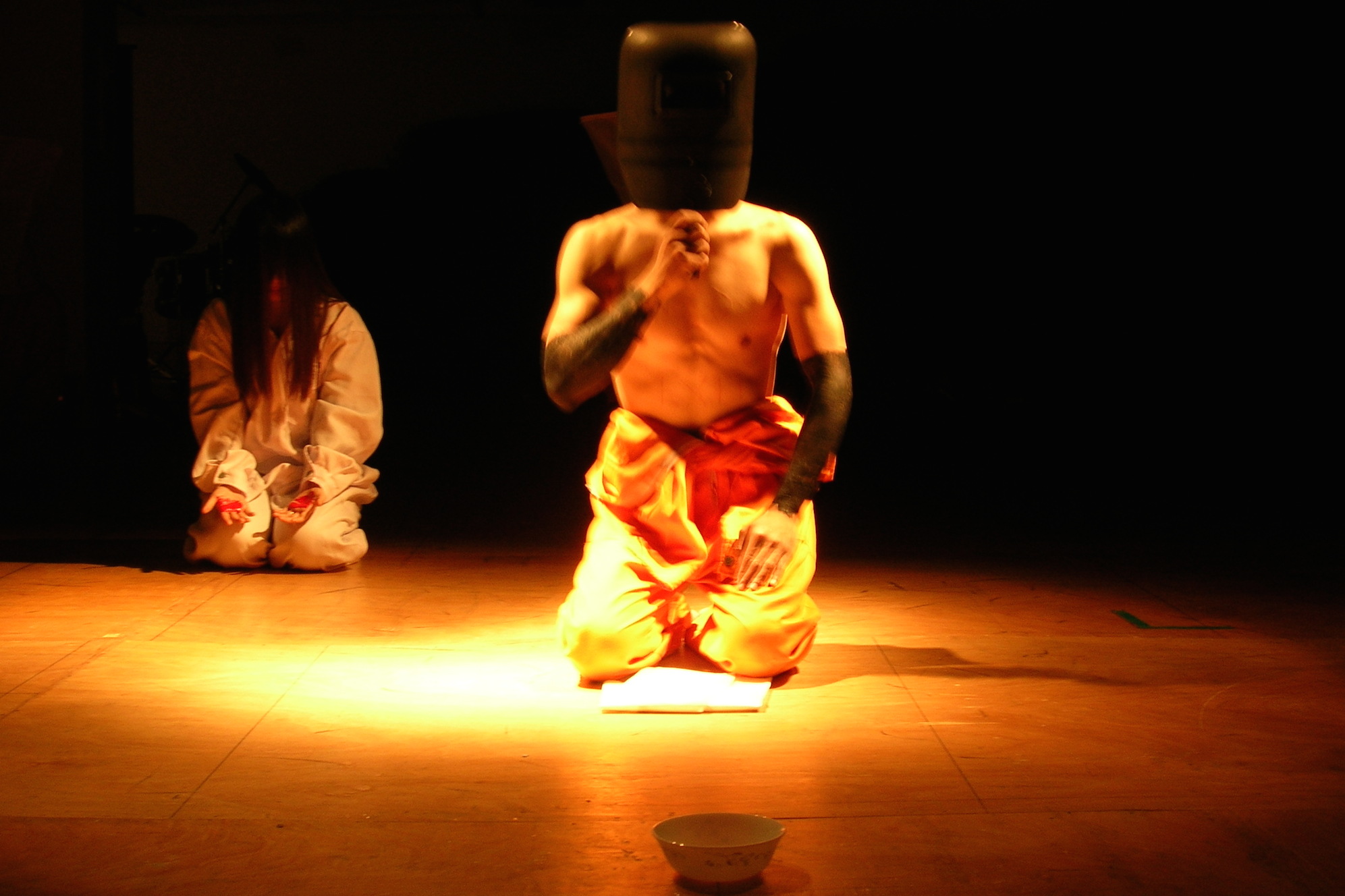
Japanese art collective, Nibroll
Last night I skimmed through two dvd's I purchased in Tokyo. The first, Memorandum, is the third video release from the Kyoto-based performance art group, Dumb Type. Dumb Type, to be perfectly forthright, has changed my life. It was during my time at the MIT Media Lab observing intersections among art and technology that I realized there lacked a presence, personality, and physicality in the digital. I moved from programming screens toward the other extreme in performance. I decided to experiment with my body and do things live. I dropped graphic design from a double major to focus on interrelated media. If anything, the switch was a relief to a developing carpel tunnel. I would soon integrate performance and installation books on Tatsumi Hijikata, Marina Abromovic, and Dumb Type with the writings of John Maeda and Bruce Mau. I would also begin attending experimental sound performances in Boston. My ear has since been spoiled to the joyful subtleties of sine wave generated tones.
Dumb Type and Nibroll are artist collectives. The works of each group is the result of a collaboration between a wide range of creatives from set designers, choreographers, fashion designers, video and media artists, sound artists to architects, writers and painters. As a result, the work is difficult to categorize. Dumb Type emerged in the eighties and Nibroll during the last several years. Each group has been flexible and decentralized. Ryoji Ikeda and Alfred Birmbaum of Dumb Type continue their individual careers as sound artist and writer, respectively. Off-Nibroll is a Nibroll spinoff collaboration between Nibroll's choreographer Yanaihara Mikuni, imagery specialist Takahashi Keisuke and Australian choreographer Jo Lloyd. Nibroll produces media and also has a fashion line and store.
Dumb Type allowed me to break from what I was doing while integrating what I had learned (typography, composition, framing) into what I wanted to do. They continue to inspire me. The influence of Dumb Type is also clear in Nibroll, yet Nibroll has extended into so many different areas of creative production with an agility and quick turn-around that Dumb Type has not been able to realize. Both demonstrate what art can be if the right personalities get together and work for something. They take the experimental spirit of Warhol's New York factory of the sixties without inflated ego (that would be juggernaut Takashi Murakami's Tokyo art production factory of this decade).
For further reading
Dumb Type
Nibroll
Off Nibroll
Studio for Interrelated Media
AttackTheatre
Posted by rst at 05:52 PM | Comments (0) | TrackBack
August 30, 2005
NTU Fall-Winter 2005 Collection

Ngo Thai Uyen. Fall/Winter 2005 Collection
This Sunday artist and designer Ngo Thai Uyen introduced her Fall/Winter 2005 Collection at the Đẹp Fashion Show at the brand new Park Hyatt Saigon. The latest show, directed by Nguyễn Việt Tú, highlights five of Ho Chi Minh City's designers (Xuân Sơn, Ngô Thái Uyên, Nguyễn Hữu Lợi, Pearl Hà, and Công Trí), within a standard catwalk. The designers also displayed their customized Vespa's alongside their collections in an exhibition space downtown.
Uyen is also an artist as well as a designer. Last year she had a solo painting exhibition at Mai's Gallery and has performed/exhibited work in the US and Japan. Uyen and I also comprise two artists of five in the Saigon-based artist collective, ProjectOne. This also serves as a segue to my next post, about the Japan-based art collectives Dumb Type and Nibroll.
Further Reading
Netmode. Hình ảnh Đẹp Fashion Show Thu Đông 2005
Posted by rst at 04:56 PM | Comments (0) | TrackBack
August 29, 2005
Arts Library - Phase Two

Prowling the city for good books
"Art lovers receive a cerebral treat" is the title of a recent article on Vietnam News about the arts library in Ho Chi Minh City. I can't help but conjur the image of Hannibal Lechter watching that poor guy eat his own brain in the Silence of the Lambs sequel, Red Dragon. Anyhow, by bookstore hopping, I was able to acquire some valuable additions to the arts library during my short time in Tokyo last week (between torrential downpours from Typhoon Mawar)- including an absolutely delicious arts quarterly called ARTiT. The Mizuma Gallery donated two amazing books for the library. In the near future, we hope to add a media station for video and experimental sound art. I'll be heading to SB in the next days to post new exhibition, residency and events information on the bulletin board.
If anyone has experience or suggestions on how to improve the arts library, please contact me. Click the image above for larger view.
For further reading
diacritic. Arts Library - Phase One
Vietnam News. Art Lovers Receive a Cerebral Treat
ARTiT. Website
Mizuma Gallery. Website
Posted by rst at 04:42 PM | Comments (0) | TrackBack
August 27, 2005
Tokyo Photo Gear


I purchased two film cameras while in Tokyo. The Babylon.4 (¥5000) has four settings that populate four cells on a single frame. Hard to explain, but visit the website. It's in Japanese, but you'll get the idea. I hope some interesting works will come out these experiments. The other camera, the diminutive Harinezumi(¥1500), is a small keychain camera to which you attach a 110 film cartridge.
The typhoon destroyed chances for good street photography, especially people watching in Shinjuku. I wasn't able to take any great images, at least I was able to bring back cameras instead.
I'm trying to loosen up. I'm frustrated by the pixelization and poor images I've been getting in low-light conditions with my digital camera. The digital processing within the camera has given me some god-awful images. I'm switching to film for some projects, where I also have the opportunity of blowing up images without loss. Wish me luck.
More Info
Babylon.4
Harinezumi
Polga Cameras
Superheadz
Posted by rst at 03:27 PM | Comments (0) | TrackBack
August 20, 2005
HPAIR: Visualizing Asia (Tokyo)

600 Images Project. Thailand Exhibition.
I will travel to Tokyo tomorrow evening for this year's HPAIR (Harvard Project on Asian and International Relations) as a speaker in the workshop Visualizing Asia: Global Culture and National Narratives in Contemporary Art.
The visual arts function paradoxically in Asia: works are at once produced in accord with a series of global paradigms, and interpreted as manifestations of particular national social realities. This workshop will look at the systems of production, circulation, and valuation known collectively as ‘contemporary Asian art’ with an eye to how different kinds of institutions, spaces, displays, and markets for visual artifacts reflect broader cultural and geopolitical trends.
This is accomplished in different sessions throughout the 4 day conference of which contemporary art is only one component spanning politics, economics and social issues. I'm fortunate to be paired with a colleague that I've had the pleasure of working on a number of projects before in Thailand.
SESSION 6: 15:40-17:00, August 23, 2005 Alternative spaces, Independent projects Radically creative new art spaces have erupted across Asia in the past few years, not fitting neatly into established categories of display culture. This session looks at a few of them with an eye to the question: what can the art world at large learn from Asia?Jeab Gaweewong, Curator. (Bangkok, Thailand)
Rich Streitmatter-Tran, Artist (Ho Chi Minh City, Vietnam)
As we each only have around 30 minutes to deliver our presentations. I intend to give a quick overview art production and spaces in Ho Chi Minh City and Hanoi, including the developing Saigon Biennale projects. I hope to also share events and examples of cooperative arts projects along the Mekong region.
Posted by rst at 05:22 PM | Comments (1) | TrackBack
August 17, 2005
The Kentucky Fried
The city of Bowling Green, Kentucky unanimously voted to recognize the former South Vietnamese flag.
"Backed by a large crowd of local Vietnamese-Americans the commission voted unanimously to adopt the former flag of South Vietnam as the official flag of the local Vietnamese community. Many of the supporters tonight are refugees who came to America during the Vietnam war and many were moved to tears at the symbolic gesture."The people who have come from South Vietnam who have lived under Communist rule really want the world to know the true flag of Vietnam is the South Vietnam flag," said Mayor Elaine Walker"
---
Mayor Elaine Walker went on to decree that the true flag of Kentucky is the Confederate Flag. Many Kentucky residents and small armed militias who have yet to come down from the bluegrass hills consider it to be the national flag (despite the Confederacy having not existed for nearly 145 years). A parade was scheduled shortly after the opening ceremonies. Revelers marched in a parade down Main Street in a spectacle not seen since Sea Biscuit won the Kentucky Derby in 1938. Backwards Vietnamese Americans and the KKK waved to their supporters from a replica of the "Dukes of Hazzard" car, The General Lee, called by the Vietnamese, "Đại tướng Ly". When questioned about American history, many Vietnamese admitted not knowing who General Lee was, but were able to identify Colonel Sanders. One KKK member, of East German heritage, removing his hood was also visibly moved to tears, and expressed his lifetime work to see that Kentucky too would recognize the forgotten flag of the former East German State. African Americans looked on in disbelief.
Further reading
WBKO. BG City Commission Adopts South Vietnamese Flag
SJ Mercury News. San Jose Council vote affirms flag of old Vietnam
BAL. Rest in Peace
Posted by rst at 05:41 PM | Comments (6) | TrackBack
August 16, 2005
GIFF2005/PAAF2005, Korea

Gwangju International Film Festival (GIFF)
Today I received the thrilling news of the inclusion of my longtime friend's short film in the upcoming 2005 Gwangju International Film Festival.
Title:Flight song (Korea, 2005, 20min 38sec, 16mm, color)
Director: Cha Yoon-jooSynopsis: Yu-Jin who is looking for books her father cherished desparately to find memories of childhood. The moment she got her hands on a book of her father, she found a trace of another person in that book.

Pocheon Asian Art Festival (PAAF2005)
I've been invited to exhibit work at the 2005 Pocheon Asian Art Festival. The festival director, Jin Sup Yoon (Curator for 1st and 3rd Gwangju Biennale, the 25th Sao Paulo Biennale, and the 3rd Media City Seoul 2004 artistic director) has assembled what seems to be an interesting first international contemporary art festival for the city. An interview on the PAAF website provides more information.
Posted by rst at 05:30 PM | Comments (0) | TrackBack
August 14, 2005
Performance Art Saigon
This week saw two important performance art related events in Ho Chi Minh City. As the notion of contemporary art in Vietnam expands into installation, new media and performance, venues are slowly emerging to accomodate the growing interest.
Saigon Biennale Co.

As a part of its new programming, the Saigon Biennale Co this week hosted two events with Trefethen Professor of Art History at Mills College Moira Roth. Earlier this week Professor Roth presented an overview of American Performance Art which was later followed up with a performance art workshop. Both events attracted a large and varied audience from artists, poets, modern dancers and journalists. At the workshop, ProjectOne (performance art group), Le Vu Long (choreographer)and Open Mouth (spoken word) shared their recent work.
Blue Space Gallery

At the Blue Space Gallery, Bangkok-based performance Artist Chumpon Apisuk shared his vision of international and Asian performance art with a group of artists. As founder and organizer of the annual Asiatopia performance art festival, Chumpon has connected performance artists throughout the Asia Pacific region.
Posted by rst at 10:45 PM | Comments (0) | TrackBack
Pimp my Vespa

As a component of the upcoming Dep Magazine Fashion Show in Ho Chi Minh City, each designer was also given the task of customizing a new Vespa LX150. Above, Ngo Thai Uyen and I inspect after the application new paint and stencils to the bike. Tomorrow we will be returning for final detailing. The final work will be unveiled at the upcoming show.
Posted by rst at 10:31 PM | Comments (0) | TrackBack
August 12, 2005
Management of Culture Industries
Two articles yesterday relate to the administration of culture industries in China and Vietnam, extending into art, cinema and publishing. The first article found on Danwei:
Chinese news Xinhua published a report on the "State Council's several Decisions on guiding non-public capital into the cultural industry."
1. Encourage and support private funds entering the following areas: Performing arts troupes, performance venues, museums and exhibition halls, Internet service venues, art education and training, art and cultural exchanges, travel cultural services, cultural entertainment, art object management, cartoons and Internet games, advertising, production and distribution of films and TV programs, broadcast technology development, movie theaters and movie theater cables (i.e. digital delivery of movies to cinemas), film screenings in rural areas, retail and distribution of books and periodicals, retail and distribution of audio and video products, printing of packaging and decorative printed items.
However,
9. Private funds are not allowed to invest in, establish or operate news agencies, newspapers, publishing companies, radio stations or channels, TV stations or channels, broadcast relay stations, broadcast satellites, satellite ground stations, transfer stations, microwave stations, monitoring stations, cable TV network backbones etc.; they are not allowed to use information networks to develop audio-visual programming services and news websites; they are not allowed to operate editorial sections of newspapers, TV broadcast frequencies and programs, operate books and newspaper publishing, movies and TV, audio-visual productions and such cultural product import operations; they are not allowed to operate state-owned museums.
In short, there appears to be an encouragement/relaxing of rules regarding production with a tightening of rules regarding distribution. It is a win-win situation for the State meanwhile everything remains as ambiguous as ever with those responsible for the creation of the work. The state ultimately has the power to not broadcast, distribute, publish, inform the public about the works it has encouraged its creative communities to create.
Vietnamese Thanh Nien News selects as its English-language editorial Privatising cinema: Is it the right time?. Vietnamese cinema remains a state enterprise. The Vietnamese goverment has recently raised the development of its national cinema to one of its highest priorities among other cultural forms. There have been numerous articles of Vietnamese directors going overseas to observe foreign production techniques, film and video equipment expositions featuring the latest technologies, and information on overseas Vietnamese and Chinese film. However, the focus has been on the development of the technical aspects of film production at the cost of the creative. As a result, Vietnamese films have been riddled with stereotype, poor acting, techical blemishes, problematic narratives and editing continuity, and passionless writing. A problem can be found in the following quote from Le Cong Hung, Deputy Director of Vietnam’s Film Import-Export and Distribution Corporation (Fafilm):
"After privatisation, companies will have to balance their own finances, meaning they will be faced by the prospect of personal financial ruin. State-owned studios would then be challenged by private enterprises determined to succeed."
If there's no risk in making art, it follows there's no incentive to make quality work. If the studios continue to rely on budgets and authoring from the State without the prospect of failing, then the films will not improve. If the State is the primary financier, with control over the writing to the final distribution (as in the China article), then there is also no incentive to make challenging and engaging films. Privatization of cinema will ensure that each studio works to produce its best films at the risk of the demise of their studio, not from intervention, but from a lack of creativity and ability to connect with their audience.
However, I do agree with Mr. Le on the point:
"What the film authorities are most concerned about is that with privatisation, film producers will focus on sensational topics like this, abandoning the historic and artistic ones that state-owned studios focus on."
There exists a very real possibility that the privatization the entire film industry would come at the cost of films that address social concerns. Documentaries, for example, would be severely affected.
“Our biggest problem is that we do not have professional film producers, which has left our film industry far behind the rest of the world. But with that background and the challenges we currently face, is now the right time for us to privatise the national film industry?” Mr Hung pondered.
My opinion is that Vietnam should move toward the privatization of cinema as it moves ahead with the privatization of other industries. The movement should be towards privatization with the implementation of initial safeguards to sustain and support specific crafts most likely to be severely affected, as in the non-commercial sectors in art, cinema and literature. The privatization of Vietnamese cinema will attract those professional film producers that the industry laments not having.
Further Reading
Danwei. Media regulation in China: Closed open closed open for business
Thanh Nien News. Privatising cinema: Is it the right time?
China News. Private fund OK'ed for culture industry
Posted by rst at 02:53 PM | Comments (0) | TrackBack
August 09, 2005
Maximalism

Boston. My room (2003).
You're a fucking mess. Thanks.
Further reading
NYTimes. There's a Method to the Mess
Posted by rst at 02:36 PM | Comments (0) | TrackBack
August 08, 2005
Media Arts

In Almodovar's recent film, La Mala Educación (Bad Education), Enrique has a routine of clipping articles and images from the daily tabloids which in turn become materials and inspiration for his films (not unlike this blog). The fictional director realizes there is relationship between the unbelievably outrageous stories found in the tabloid press and the unbelievably outreageous reality we that we live.
When theorist and cultural critic Marshall McLuhan coined the phrase, "The Medium is the Message" he meant, "We can know the nature and characteristics of anything we conceive or create (medium) by virtue of the changes - often unnoticed and non-obvious changes - that they effect (message.)
This week begins the Edinburgh Fringe, "for decades, the world's largest and most anarchic arts festival". Just weeks after the terrorist bombings in London, the festival intends to take on the issue of terrorism head-on. A recent CNN article on the festival writes:
"One journalist asked me if shows should be canceled because of terrorist references. Absolutely not. It is absolutely right that what is covered in newspapers and on television should be covered in the arts," he said.
"McLuhan warns us that we are often distracted by the content of a medium (which, in almost all cases, is another distinct medium in itself.) He writes, "it is only too typical that the content of any medium blinds us to the character of the medium."
I'm often asked, what media art is, since its printed below my name on my business card. For me, media arts is a response to the world as it occurs. It is both an observation of change (real, perceived or both) as well as an vehicle for change. It is less about the material/medium (be it video, sound, computation, or plaster), or even the final artwork itself (an exhibition, installation, a performance, or screening). It is about the interaction, the play, the questioning of social and cultural phenomena. It's about commenting on our lives rather than simply dragging through it.
Painter or sculptor, working in textiles or bronze, accessed through video or performance - artists are a curious bunch hopefully moving toward better a understanding of the very ordinary cultural and communications detritus that fill our lives (among them: newpapers, broadcast television, cinema, advertising). For me, that's media art.
Further Reading
Mark Federman. What is the Meaning of The Medium is the Message?
IMDB. Almodovar's Bad Education
CNN. Terror to fore at Edinburgh Fringe
Edinburgh Fringe
Posted by rst at 03:18 PM | Comments (0) | TrackBack
Beijing International Gay and Lesbian Film Festival
Check out the BIGLFF website and the commentary on Supernaut.
"The focus of this new Festival will indeed be on “Sex Health”, a theme generally referring to sex conception, sexual orientation policies, gay theories, gender behavior, AIDS prevention, sex trade and society protection.Desire needs to regain its identity as a natural attribute and a personal right. It's a discrimination to ignore sex orientation. Therefore, we wish our new film Festival can tackle Chinese sex education and topple the image of immorality Chinese homosexuals have had for far too long."
Vietnam recently had its 14th national film festival last November in Buon Ma Thuot City in the central highlands. It may be years until Vietam might host an international film festival and years after for an international gay and lesbian film festival. But as Vietnam sets priorities on the creative and technical development of its developing film industry, hopefully we'll be screening innovative work sooner than later.
Bad Mouthing the Chinese
One thing I can't stand is the spelling of Chinese names to fit the Vietnamese language. Nobody knows Zhang Yimou or Zhang Ziyi though are more familiar with Trương Nghệ Mưu and Chương Tử Di than their next kin. My problem is no so much the phoneticization in speech (different tonal systems, etc), but of consistency. Both are have the surname Zhang, but Trương and Chương are different. Take your best shots for Trần Khải Ca, Hầu Hiếu Hiền, Maggie Q, and Củng Lợi (Chen Kaige, Hou Hsiao-Hsien, Maggie Cheung, Gong Li.) The worst example is Lưu Đức Hoa (Andy Lau), although if you're Chinese, you know him as Lau Tak Wah, which is sort of close. Gong Li can almost be said correctly in Vietnamese so why the skewing of "Li" as "Lợi", when "Ly" is a popular surname in Vietnam? It's a bad habit and one they do not do with western surnames, or even Korean or Japanese. As for my name, when published, they tend to jsut omit the Streitmatter altogether and print "Tran". Catherine Jones is likely someone other than Catherine Zeta-Jones, dig? So when Vietnamese want to do google searches on popular Chinese personalities, the only results that turn up are those in the Vietnamese press. Hmmm.
Put it to the test. Scan today's article on Tuoi Tre about the reuniting of Zhang Yimou and Gong Li for the first film in 13 years in Autumn Remembrance. See how many names you can guess (Rob Marshall does NOT count).
More reading:
BIGLFF
Supernaut. BIGLFF
VietnamNet. Central Highlands hosts national film fest
Posted by rst at 10:26 AM | Comments (0) | TrackBack
August 06, 2005
Great Walls

On the Construction of Walls, the Destruction of Books and Art
I was reading last evening one of Borges' great essays, The Wall and the Books, on the construction of the Great Wall of China and the Burning of Books by Emperor Shih Huang Ti. Both projects were of massive scale. "Borges’ sees Shih Huang Ti’s gargantuan fortification project as inseparable from his burning of every book that preceded his reign so that history might begin with him."
The Great Wall of China, no longer a strategic defence has become a pathetic offense. Now an exotic mise-en-scene for tripped-out westerners for piss leaks between coke snorts and screwing. Scroll to the photos on bullet 74. The Great Wall and the Burning of Books failed to stop history and yet the strategy persists. China has retooled the two enormous tasks of construction and destruction for the 21st century with the Great Firewall of China, made possible with the enthusiastic support of Microsoft and Cisco. The GFWofC is the most advanced national firewall to date. It accomplishes the two-fold vision of Emperor Shih Huang Ti as if it were on crack: advanced blocking technologies coupled with panoptic surveillance technologies for later information destruction.
Meanwhile, Israel awakes to find itself walled-in by its own wall. Art prankster sprays Israeli wall:
Secretive "guerrilla" artist Banksy has decorated Israel's controversial West Bank barrier with satirical images of life on the other side. The nine paintings were created on the Palestinian side of the barrier.
Minthy has posted information on an upcoming forum in San Francisco (August 18, 2005) on the topic Graffiti: Urban Scrawl or Artistic Freedom:
From its contemporary origins in the late 1960s, graffiti has spread globally, from the city and boroughs of New York to walls around the world. Some see the proliferation of graffiti as a veritable modern plague, an urban blight that clearly diminishes quality of life. Others would argue that today's graffiti is a historically significant art form, providing a unique means of creative _expression to the disenfranchised and marginalized. Are the words of the prophets truly written on subway walls and tenement halls, or is graffiti nothing more than mindless vandalism that is directly linked to a host of societal ills? You be the judge.
The issue of guerilla art and the public space has even found a mention in the Vietnamese press. In Thanh Nien News: Graffiti - Nghệ thuật hay tội lỗi?
FURTHER READING
The Great Wall of China
Danwei. Republicans and Democrates Angry at Uncle Sam's Corporations
Imagethief Keep Your Filthy Orgy Off Our Wall
Guardian Unlimited. Beijing's bitch
Wired News. Chinese blogger slams MS
Gadfly. The New! Improved! Great Wall of China!
Graffiti
WestPress. On the West Bank-sy
Guardian UK. Banksy strikes on West Bank barrier
Sky News. Cult Artist Hits Barrier
Posted by rst at 02:35 PM | Comments (1) | TrackBack
In Our Expert Opinion
The Ministry of Culture and Information has discovered several arts galleries and spaces operating without a permit and the "cultural content of items in general was not to its liking". Furthermore, exerpted from an article in Ha Noi Moi:
Three galleries and sculpture workshops, one in Hoan Kiem and two in Tay Ho, were found to have operated without a license, a problem the Ministry admits it couldn’t police effectively due to a shortage of human resources, especially professional critics and experts in the area.
Huh? Let's encapsulate. MCI has dicovered cultural content not to their liking but lack the resources to take action because they are unable to gather support among professional critics or experts? You've got to love it.
Read the full article on VietnamNet
Posted by rst at 10:32 AM | Comments (0) | TrackBack
August 05, 2005
The Loudest Sound

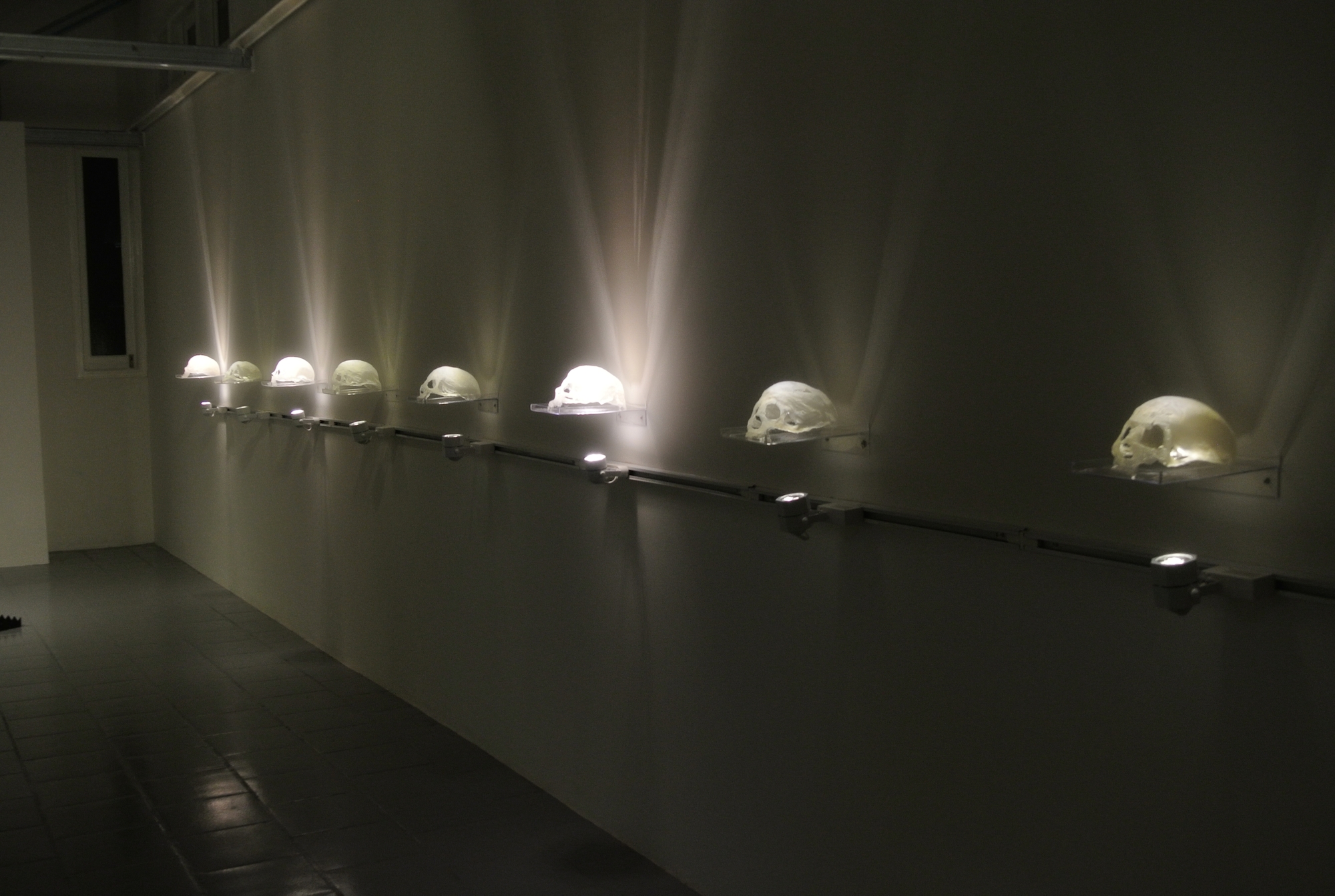
I will be posting photos just received just this week from the curators Brian and Mark of Pallas Studios and Catherine, a new friend (and friendster) from Dublin, of the installation at the Hugh Lane Gallery. But here are two images from the installation, The Loudest Sound. -RST
Posted by rst at 04:23 PM | Comments (0) | TrackBack
The Seven Year (Jock) Itch

Under a proposal workers with with at least seven years are entitled to a salary raise of 70,000 dong (approximately $4.40). From Intellasia News:
Mass strike over wages at Nike sub-contractor factory
02/Aug/05 Nong Thon Ngay Nay, page 11
Over 8,000 workers went on strike over pay claims on July 29 at a Nike sub-contracting company Changsin Co of Korea at Thanh Phu commune in the Dong Nai district of Vinh Cuu.
The striking workers asked the executive board to reconsider the new salary regime announced on July 28. They said the provision in the wage increase document was unfair. Workers who had worked for the company under three-months are not in any wage raising list, employees working from four to 12 months will receive 30,000 dong more, employees working from one to four-years 60,000 dong more, employees working from four to seven-years 65,000 dong and employees who had worked over seven-years 70,000 dong.
Meanwhile, announced on the same day, Adidas acquires Reebok competitively placing it as the number two sportswear giant to Nike. Adidas has a store in HCMC on Hai Ba Trung Street. How long would it take to save up for a pair of 1,985,000 dong sneakers (which is nearly two months rent for me). I wouldn't know, I buy Converse in Thailand for 209 Baht ($5) and Puma at Ben Thanh Market for 200,000 dong ($12.50).
For further reading:
Some of these are old links, addressing issues existing seven years ago. I suspect things have improved. But, here they are, old and new:
General info on Nike's investment activities in Vietnam
Nike Shoe Plant in Vietnam Is Called Unsafe for Workers
Nike-Viet Nam exports 750 million USD in 2004
and perhaps the strangest of all on BBC News....
Nike slams Vietnam labour critics
Posted by rst at 12:11 PM | Comments (0) | TrackBack
August 04, 2005
A Society without Fathers or Husbands

Tarnation is one of the best films I've seen in recent months (along with Kore-eda's "Nobody Knows", Nathaniel Kahn's "My Architect", Ron Fricke's "Baraka", and Tsai Ming-Liang's "A Wayward Cloud"). Tarnation is a film years in the making. Director Jonathan Caouette constructs a painfully honest film using video and film footage as far back as 15 years ago. It was while watching this film I realized that I haven't seen or spoken to my adoptive father in over ten years. Although we've never been close, I've put off calling or writing to him. A decade comes as a suprise to me. My father, like the Jonathan's mother in the film, has been for years in and out of institutionalization for paranoid schizophrenia and psychosis.
My father left the family when I was five and my younger brother was a year old. I wouldn't see him again until I was twelve or thirteen and then again when I was 22 suffering from a broken neck. I remember writing to him as a child. Sometimes he would reply to my letters with his other persona, Rusty Stone (my father's real name is Roger Streitmatter). And he would always draw the same cartoon head with a figure-8 cowboy hat, which I would often copy onto my school notebooks. I felt closer to the image of my father, drawn, rather than the man.
As I grew into young adulthood, my father would send me pictures, often of blue tarp tents he would construct during wandering and homeless phases. He would also begin to type his letters. A year or so before I left for Vietnam I received a box with assorted junk in the mail (assorted bibles, a broken pocket watch, a can opener). Inside the box was a typed letter saying that my brother wasn't his child but not to tell anyone. The letter was unsigned, so I couldn't determine if the writing was Rusty or Roger. As time goes by, the two become more or less the same person.
As for my biological father, I first saw him when I was twenty eight. At that time he was 80 years old. I was one of the last children born of my parents. A couple years later he began to develop Alzheimer's disease and now, at 85 he has lost most of his memory. I never had the chance to speak to him.
And for 10 years, between 11 and 21, I had a step-father. We never got along. He was humorless and had strange house rules. For example, we weren't allowed to walk around the house without wearing slippers. He was also a coward. After I was sent to the Middle East during my enlistment with the army, at a desert outpost on the Gulf of Aqaba, I received a letter from my mother. In the letter, she wrote that she and my younger brother had returned home one afternoon to discover that the house had been cleared out. Everything but the refrigerator. At first they thought they had been robbed but discovered a note on the freezer door explaining everything. My step-father had packed up the house while my mother was at work and taken my two other step-brothers out of school. He blamed the escape on my younger 17 year old brother but I knew it was long in the planning. Before basic training, he told me that when I returned from basic, things might be different. Nothing changed upon my return leave from basic training. But the first Gulf War had begun and I had orders for deployment. I knew once he discovered that I was locked down in the desert, he would make his move. He knew that I knew if I were in the US, I would have returned home and killed him.
I think about my life without father's and question my own ability to be one. I'm now 33 and have no intention to be one, but enjoy playing with the baby where I work. I look at my younger brother, now a father of a two-year old daughter, and having the same fatherless childhood, I can see that he's done a great job. And then again, there's the Na people of Yunnan Province in China: A society without husbands or fathers.
Further Reading:
Mosuo Society (Yunnan)
Posted by rst at 04:30 PM | Comments (0) | TrackBack
Pendejo
Transnation Translation
The real entries on this topic can be found on EWSN and The Narcosphere. I've simply cut-and-pasted spiced with some personal commentary. But to encapsulate: Venezuelan president, Hugo Chavez in a public speech conjured the word pendejo when describing George Bush (see funny image). As an American, the first word that comes to mind is "asshole", though I would be absolutely wrong.
Reuters Spanish printed the headline:
Chávez llama 'pendejo' a Bush y rechaza intervención"El presidente venezolano, Hugo Chávez, llamó "pendejo" a George W. Bush y amenazó con cortar el suministro petrolero a Estados Unidos por financiar a grupos de personas violentas en la oposición, que protestaron por tercer día consecutivo en respaldo a un referendo contra el mandatario."
While the Miami Herald used the word chump, Petroleum word was more direct printing pendejo with a quick translation in brackets:
In his most bombastic and inflammatory rhetoric to date, Chavez characterized President Bush as "a pendejo [idiot, in vulgar terms] for allowing himself to be convinced that Chavez had been overthrown on April 11, 2002”
From Salon:
"Pendejo" is a much-loved noun, which can also become adjectival, adverbial and exclamatory. It literally means "pubic hair" -- but the meaning is more on the order of "a trouble maker," "a boor" or "a grouch." I have heard it used in relatively polite company, and it has the added advantage of being available in the feminine ("pendeja") or masculine ("pendejo") forms. Cassell's says the best definition is "a bloody nuisance."
The word does have some local variance. As an adjective, in Latin America it can mean idiotic or cowardly. In Peru, smart or cunning and in Mexico and the Caribbean, ham-fisted. As a noun, from a fool, kid to a know-it-all. But no where can it be found translated (authoritatively) as asshole.
Perhaps the misunderstanding comes from watching Spanish-language films with English subtitles. Pendejo is frequently subtitled as 'asshole'. But even asshole in the English language can vary from affectionate banter between friends "You asshole.", to annoyance "What an asshole." to rage "Asshole!"
So it is also with pendejo. What the true intent of Chavez was in using such a word he may only ever know. Yet there is another reference we might consult:
Chilaquil American English dictionary:
asshole
From the Latin arbustus
1. n. A person who resides at 1600 Pennsylvania Avenue.
Posted by rst at 02:32 PM | Comments (0) | TrackBack
August 03, 2005
McGee at Deitch

Barry McGee and Swoon open at Deitch on Wooster Street. The last time I had a chance to see McGee's work was at Brandeis University a couple of years ago. We arrived on Monday. The gallery was closed on Mondays. I did, however, find a McGee painting on board on St. Paul Street in Jamaica Plain. My friend, Ben, ended up taking it. So, I've yet to see his work and this exhibition will be another missed chance. I wish there were a wormhole connecting Saigon to New York.
Read about the exhibition in the NY Times.
Posted by rst at 04:57 PM | Comments (0) | TrackBack
Bad News Trends
This entry is a departure from my regular focus. But where it does connect is the usual focus on media. I normally wouldn't have paid these news stories much attention but for the amount of reportage in the span of a couple of weeks. Dead babies on CNN, dead babies on BBC.
In recent weeks several stories, from France to Germany, emerged of gruesome discoveries of dead babies throughout Europe. On CNN today, over 350 stillborn babies and fetuses kept illegally in a hospital morgue were discovered at the Saint-Vincent-de-Paul Hospital in Southern Paris. Yesterday's BBC news reports in the Brieskow-Finkenheerd, a small German town on the Polish border, nine new-born babies were found buried in a garden. The babies, born between 1988-2004 (nearly a generation), were found buried in flower pots. I have always felt a disgusting unease about the saccharine lettuce and sunflower babies photography of Anne Gedes, I now have a reason.
July 18: In Worchetershire, England, a six month baby was discovered entombed in a concrete block after 15 years. The baby was alive when entombed. "A post-mortem examination showed the baby had suffered a fractured skull, bruising to the abdomen and may have also been sexually abused".
May 3: "Following the arrest at her home in the Gurnos earlier today, and a subsequent search of the property, officers discovered what they believed to be the remains of two further infants, which were enclosed in bags in the attic."
The finds come after other recent grim discoveries in Germany, says the Associated Press. Last week, a dead baby girl was found in a public toilet in Magdeburg and a young boy was discovered on a recycling company's conveyer belt in Guetersloh. A walker in Lower Saxony found a dead baby in a plastic bag in June. The authorities in Austria are holding the parents of at least three of four children whose bodies were found in a freezer and concrete-filled buckets at their home.
More reading:
Hundreds of stillborn babies found
Dead babies find shocks Germany
Entombed baby unlawfully killed
Babies in freezer shock
Posted by rst at 03:05 PM | Comments (1) | TrackBack